Last updated:
“Lakhpati Didi Yojana apply online”, “Lakhpati Didi 5 lakh loan” and “Lakhpati Didi list” are among the most searched scheme queries from rural India. Many videos and websites promise an interest-free Rs 5 lakh loan or a direct online form. The official picture is different, and far more useful once you understand it: Lakhpati Didi is not a one-time cash scheme but a livelihood mission that works through women’s Self-Help Groups (SHGs). This guide explains, from the official lakhpatididi.gov.in portal of the Ministry of Rural Development, who counts as a Lakhpati Didi, who is selected, what money and loans are available, the 2026-2029 targets for every state, and the exact route to join. Checked on 26 November 2026.
Official links
Always verify dates and fees on the official website before applying.
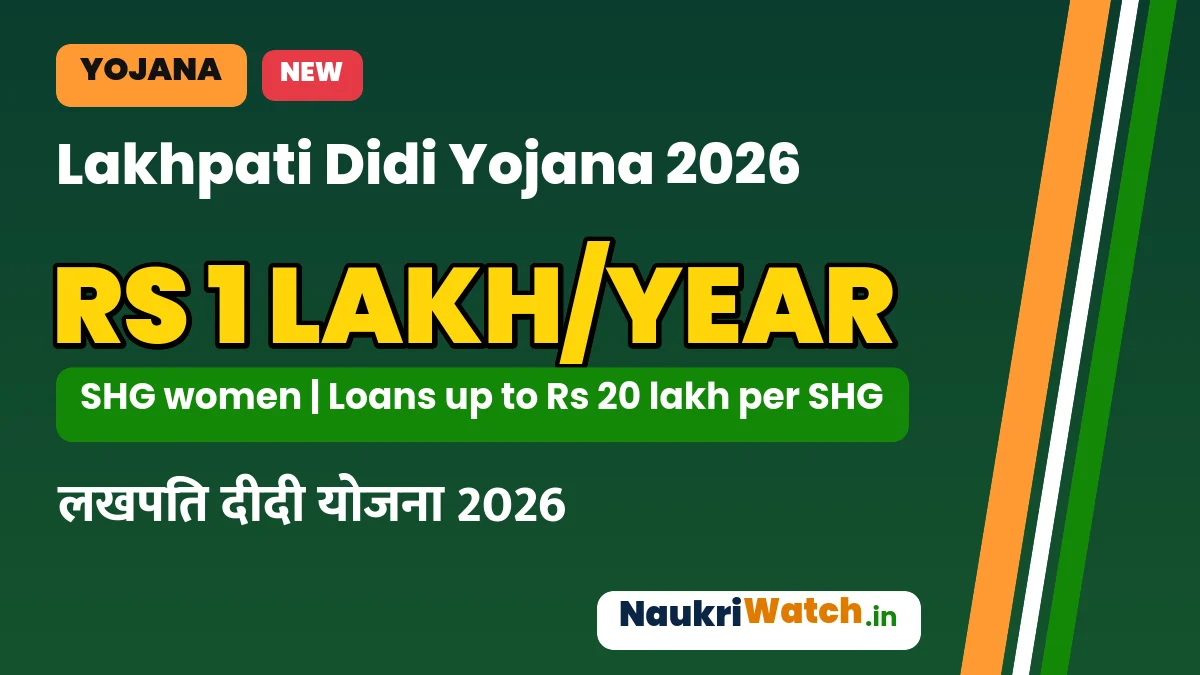
Quick answer: Lakhpati Didi is the Ministry of Rural Development’s initiative under DAY-NRLM to help women Self-Help Group (SHG) members earn a household income of Rs 1 lakh or more a year (average Rs 10,000+ a month, sustained for at least 4 agricultural seasons or business cycles). There is no separate online form: you join through your village SHG and State Rural Livelihood Mission. Support includes a Revolving Fund of Rs 20,000-30,000 per SHG, Community Investment Fund up to Rs 2.5 lakh per SHG, collateral-free bank loans up to Rs 20 lakh per SHG and credit guarantee for individual loans up to Rs 5 lakh. Official site: lakhpatididi.gov.in.
Lakhpati Didi Yojana 2026 at a glance
| Item | Details |
|---|---|
| Run by | Ministry of Rural Development, under Deendayal Antyodaya Yojana-National Rural Livelihoods Mission (DAY-NRLM) |
| Who is a Lakhpati Didi | An SHG member with annual household income of Rs 1,00,000 or more, average monthly income above Rs 10,000, sustained for at least 4 agricultural seasons and/or business cycles |
| Who can be selected (suggested criteria) | SHG member for at least 2 years who has availed Community Investment Fund (CIF), and practises at least two livelihood activities with mission support |
| How to apply | No individual online form; through your SHG, Village Organisation and State Rural Livelihood Mission (SRLM) |
| National target (2026-2029) | 410 lakh (4.1 crore) Lakhpati Didis, as per the state-wise target table |
| Progress on portal (26 Nov 2026) | 3.76 crore Lakhpati Didis; 6.48 crore potential Lakhpati Didis; 25.43 crore Digital Aajeevika Register entries; 4.79 lakh Aajeevika CRPs |
| Key money support | Revolving Fund Rs 20,000-30,000 per SHG; CIF up to Rs 2.5 lakh per SHG; bank loan up to Rs 20 lakh per SHG (collateral-free) |
| Individual enterprise loans | Credit guarantee for loans up to Rs 5 lakh (max 5 years); 2% interest subvention on loans up to Rs 1.5 lakh (max 3 years) |
| Official website | lakhpatididi.gov.in |
Who is a Lakhpati Didi? (official definition)
According to the portal, a Lakhpati Didi is a Self-Help Group member whose annual household income is Rs 1,00,000 or more. The income must be sustainable: it is calculated over at least four agricultural seasons and/or business cycles, with an average monthly income above Rs 10,000. In other words, one good harvest or one festive-season sale does not make someone a Lakhpati Didi; the income has to hold up over time.
The idea is to move SHG women beyond savings and small loans into proper livelihoods: farming with better practices, livestock, non-farm micro-enterprises and services. Income is reported every six months in the Digital Aajeevika Register, linked to the agriculture season or the end of a business cycle.
Eligibility: who gets picked as a potential Lakhpati Didi
The ministry’s FAQ lists these suggested criteria for identifying potential Lakhpati Didis:
- She is an SHG member who has completed at least two years in the group and has availed the Community Investment Fund (CIF).
- She is a beneficiary of a livelihood intervention through the mission and is practising at least two livelihood activities.
- All social and economic categories of SHGs get equal opportunity. About 25% of Didis may be targeted from households already earning above Rs 1 lakh a year, and about 75% from households earning less than Rs 1 lakh (based on a 2022 survey).
The portal says these criteria are suggestive: each State/UT may set its own criteria. So the final word on selection is with your State Rural Livelihood Mission.
How to become a Lakhpati Didi: step by step
- Join a women’s Self-Help Group in your village or ward under your state’s rural livelihood mission. If there is no group, ask the Village Organisation, the block office of the State Rural Livelihood Mission, or the local Community Resource Person (CRP).
- Save regularly and take part in internal lending. Your SHG becomes eligible for the Revolving Fund and later the Community Investment Fund.
- Take up at least two livelihood activities (for example dairy plus vegetables, or tailoring plus a small shop) with help from the mission.
- Get identified as a potential Lakhpati Didi. The mission identifies households, and a CRP prepares a Lakhpati Plan for your household using a digital tool.
- Attend training and exposure visits on livelihood models. The ministry has trained Master Trainers and CRPs to hand-hold Didis.
- Use the finance and market linkages: SHG bank loan, CIF, enterprise schemes (SVEP, One Stop Facility, MED), producer groups and e-commerce platforms.
- Report income in the Digital Aajeevika Register every six months. When your household income stays at Rs 1 lakh+ a year over four seasons/cycles, you are counted as a Lakhpati Didi.
Important: there is no official “Lakhpati Didi Yojana online registration” form for individuals on lakhpatididi.gov.in. Any site asking for a fee or your bank OTP to “register” you is not official.
Financial support available (official list)
For the SHG and its federations
| Support | Amount / detail |
|---|---|
| Revolving Fund (RF) | Rs 20,000 to Rs 30,000 per SHG (average); permanent fund for internal lending |
| Community Investment Fund (CIF) | Up to Rs 2.50 lakh per SHG, routed through the Cluster Level Federation / Village Organisation |
| Vulnerability Reduction Fund (VRF) | Rs 1,50,000 per Village Organisation for food insecurity, health shocks, calamities |
| Bank loan | Collateral-free loans up to Rs 20 lakh per SHG |
| Interest subvention | Difference between bank rate and 7% on SHG loans, for a maximum of Rs 3,00,000 per SHG |
| Overdraft | Rs 5,000 overdraft limit for every SHG woman member with a Jan Dhan account |
| Producer Group (PG) | Rs 2 lakh per PG (working capital + infrastructure) |
| Women FPOs | Rs 15 lakh equity grant per FPO over three years (with Agriculture Ministry) |
For individual women entrepreneurs
| Support | Amount / detail |
|---|---|
| Credit guarantee (Women Enterprise Acceleration Fund) | For loans up to Rs 5 lakh, maximum 5 years |
| Interest subvention on prompt repayment | 2% on loans up to Rs 1.5 lakh, maximum 3 years |
| One Stop Facility (OSF) | Scale of finance Rs 2.5 lakh for individual and Rs 5 lakh for group enterprises, with 10% own contribution |
| Aajeevika Grameen Express Yojana (AGEY) | Subsidised loans for rural transport: up to Rs 6.5 lakh for individuals, Rs 8.5 lakh for groups |
| Start-up Village Entrepreneurship Programme (SVEP) | Rs 6.5 crore per block; CRP-EP helps arrange bank finance and seed capital |
| Micro Enterprise Development (MED) | Rs 20 lakh per block to support at least 200 non-farm enterprises |
The “Rs 5 lakh interest-free loan” claim: what is true
Social media often says every Lakhpati Didi gets an interest-free loan of Rs 5 lakh. The official financial assistance page does not say that. What it lists is credit guarantee support for individual women’s enterprise loans up to Rs 5 lakh (for up to 5 years) and a 2% interest subvention on loans up to Rs 1.5 lakh for prompt repayment. The loan itself comes from a bank or financial institution and has to be repaid. SHG loans get interest subvention down to 7% on up to Rs 3 lakh per SHG. Plan your enterprise on these real numbers.
Lakhpati Didi state-wise targets 2026-2029
The portal’s target table (in lakh Didis) for 2026-2029:
| State / UT | Target (lakh) |
|---|---|
| Andaman and Nicobar | 0.03 |
| Andhra Pradesh | 39.50 |
| Arunachal Pradesh | 0.25 |
| Assam | 19.26 |
| Bihar | 64.50 |
| Chhattisgarh | 14.80 |
| Dadra and Nagar Haveli & Daman and Diu | 0.10 |
| Goa | 0.29 |
| Gujarat | 7.75 |
| Haryana | 3.03 |
| Himachal Pradesh | 2.02 |
| Jammu and Kashmir | 3.64 |
| Jharkhand | 18.71 |
| Karnataka | 16.31 |
| Kerala | 18.73 |
| Ladakh | 0.08 |
| Lakshadweep | 0.02 |
| Madhya Pradesh | 18.00 |
| Maharashtra | 17.50 |
| Manipur | 0.45 |
| Meghalaya | 1.00 |
| Mizoram | 0.24 |
| Nagaland | 0.30 |
| Odisha | 22.00 |
| Puducherry | 0.29 |
| Punjab | 0.76 |
| Rajasthan | 11.50 |
| Sikkim | 0.22 |
| Tamil Nadu | 20.71 |
| Telangana | 10.90 |
| Tripura | 1.87 |
| Uttar Pradesh | 42.50 |
| Uttarakhand | 1.66 |
| West Bengal | 52.00 |
| Total | 410 |
Bihar (64.5 lakh), West Bengal (52 lakh), Uttar Pradesh (42.5 lakh) and Andhra Pradesh (39.5 lakh) have the biggest targets, which means the largest numbers of SHG women to be identified and supported in these states.
Documents to keep ready
The portal does not publish a fixed document list for individuals, because selection happens through the SHG. In practice, banks and the mission will ask for the usual KYC when your SHG or enterprise takes a loan. Keep these ready:
- Aadhaar card (and Aadhaar-linked mobile number)
- Bank account, preferably a Jan Dhan account (needed for the Rs 5,000 overdraft)
- SHG membership details (group name, passbook, meeting records)
- Ration card / income details of the household
- Simple business plan or Lakhpati Plan prepared with the CRP
- Passport-size photographs
Common problems and fixes
| Problem | What to do |
|---|---|
| No SHG in my village | Contact the block office of your State Rural Livelihood Mission or the Village Organisation; they form new groups |
| I am in an SHG but not identified | Ask if your group has received CIF and whether you practise two livelihood activities; these are the suggested criteria |
| Website asks for a registration fee | Do not pay. There is no individual paid registration on the official portal |
| Bank refuses SHG loan | SHG loans up to Rs 20 lakh are collateral-free under DAY-NRLM; take the SRLM block staff or CRP with you |
| Where to sell products | Mission links include esaras.in, Saras Gallery, Saras Melas and tie-ups with e-commerce platforms |
FAQs
Q. What is Lakhpati Didi Yojana?
A. It is an initiative of the Ministry of Rural Development under DAY-NRLM to help women SHG members reach a sustainable household income of Rs 1 lakh or more per year through livelihoods, training, finance and market support.
Q. How can I apply for Lakhpati Didi Yojana online?
A. There is no individual online application. You must be a member of a women’s Self-Help Group under your state’s rural livelihood mission; potential Lakhpati Didis are identified through the SHG and Village Organisation.
Q. Who is eligible for Lakhpati Didi?
A. The suggested criteria are: SHG member for at least two years who has availed Community Investment Fund, and a beneficiary of a mission livelihood intervention practising at least two livelihood activities. States may add their own criteria.
Q. Do Lakhpati Didis get an interest-free loan of Rs 5 lakh?
A. The official portal lists credit guarantee support for individual enterprise loans up to Rs 5 lakh and 2% interest subvention on loans up to Rs 1.5 lakh. It does not describe a Rs 5 lakh interest-free loan; bank loans must be repaid.
Q. How much loan can an SHG get?
A. Collateral-free bank loans up to Rs 20 lakh per SHG, with interest subvention to 7% on up to Rs 3 lakh per SHG.
Q. What is the Lakhpati Didi target for 2026-2029?
A. The state-wise target table on lakhpatididi.gov.in totals 410 lakh (4.1 crore), with Bihar at 64.5 lakh, West Bengal 52 lakh and Uttar Pradesh 42.5 lakh.
Q. How many Lakhpati Didis are there now?
A. The portal home page showed 3.76 crore Lakhpati Didis and 6.48 crore potential Lakhpati Didis when we checked on 26 November 2026.
Q. What is the Digital Aajeevika Register?
A. A digital record where SHG members’ livelihood activities and income are reported every six months; the portal showed 25.43 crore register entries.
Related: PM Jan Dhan Yojana account, Kisan Credit Card apply, PM Matru Vandana Yojana, Majhi Ladki Bahin Yojana.
Source: Ministry of Rural Development, lakhpatididi.gov.in: About Lakhpati Didi, How do I become a Lakhpati Didi (FAQ), Financial Assistance and State Wise Targets (2026-2029) pages, and home page counters, checked 26 November 2026. No screenshot: the portal’s pages did not render fully in our browser at the time of checking.
Official links
Always verify dates and fees on the official website before applying.
Get free job alerts
New govt, bank and teaching jobs, admit cards and results. No spam.