Last updated:
Before you buy a plot, a flat or agricultural land in Tamil Nadu, or before a bank sanctions a home loan, everyone asks for one document first: the Encumbrance Certificate (EC). It lists every registered transaction on a survey number for the period you choose, such as sales, mortgages, gifts, settlements and releases, so you can see whether the property is free of loans and who the past owners were.
The good news is that the Tamil Nadu Registration Department lets you search and apply for an EC online for any Sub Registrar Office (SRO) in the state on its TNREGINET portal. This guide walks you through the View EC search, the online EC application, the official fee table, certified copies of registered documents, and the current stamp duty and registration fee rates, all taken from tnreginet.gov.in and checked on 27 November 2026.
Official links
Always verify dates and fees on the official website before applying.
Quick answer: how to check EC online in Tamil Nadu
Open tnreginet.gov.in, switch to English, go to e-Services > Encumbrance Certificate > View EC. Choose Survey Wise (or Plot/Flat, Ward/Block or Document Number), select Zone, District and Sub Registrar Office, enter the EC start and end dates, village and survey number, type the captcha and click Search. To get a digitally signed EC, click Apply Online EC and log in. The official fee for one survey number is Rs 1 application + Rs 30 for the first year + Rs 10 for each extra year, plus Rs 200 for the computerised period (from 1987).
Tamil Nadu EC at a Glance
| Item | Details |
|---|---|
| Portal | tnreginet.gov.in (Registration Department, Government of Tamil Nadu) |
| Menu path | e-Services > Encumbrance Certificate > View EC |
| Search types | Survey Wise, Plot Flat Wise, Ward Block Wise, Document Number Wise, Previous Document Number Wise |
| Who can search | Anyone; the property owner does not have to apply |
| Digitally signed EC | Apply Online EC (needs a TNREGINET login); EC is delivered in your login after paying the fee and delivery charges |
| EC fee (one survey number) | Rs 1 application + Rs 30 first year + Rs 10 per additional year + Rs 200 for the computerised period (from 1987) |
| Urgent EC (non-computerised period) | Double the required fee |
| Offline option | Free EC application form at every SRO (also downloadable for the pre-computerisation period) |
| Complaints helpline | 9498452110 / 9498452120 / 9498452130 |
| Software helpline | 1800 102 5174 |
| helpdesk@tnreginet.net |
What an Encumbrance Certificate Shows
An EC is an extract of the registration records kept by the Sub Registrar. For the survey number and the years you choose, it shows each registered document: the document number and year, the date of registration, the nature of the deed (sale, mortgage, settlement, release, partition and so on), the parties, and the extent of land. If nothing was registered in your search period, the result says that no documents were registered during the search period, which is what people loosely call a “Nil EC”.
Banks use the EC to check that the land is not already mortgaged. Buyers use it to trace the chain of ownership for 13, 30 or more years. The Tamil Nadu Citizen Charter itself advises that on deciding to purchase a property you should first ascertain the transactions on it by getting the encumbrance certificate.
- Home loans: banks commonly ask for an EC covering 13 to 30 years.
- Property purchase: confirms the seller really owns the land and that there is no pending mortgage.
- Patta transfer and mutation: revenue offices often ask for the EC with the sale deed.
- Court and legal work: proof of encumbrances on a property in partition or succession cases.
How to View EC Online on TNREGINET (Step by Step)
The free View EC search does not need a login. Follow these steps exactly as they appear on the portal:
- Open tnreginet.gov.in/portal. The site opens in Tamil; click English at the top right. Close the “Presence Less Registration” pop-up if it appears.
- In the top menu go to Services > e-Services > Encumbrance Certificate > View EC.
- Under Property Details based Search pick Survey Wise for land, Plot Flat Wise for an approved layout plot or apartment, or Ward Block Wise for town survey (ward and block) numbers. If you know the registered deed number, use Document Number based Search instead.
- Choose Registration Village (the village name used in the SRO records) or Revenue Village (the village name in the revenue/patta records).
- Select the Zone (Chengalpattu, Chennai, Coimbatore, Cuddalore, Madurai, Ramanathapuram, Salem, Tanjore, Thirunelveli, Trichy or Vellore), then the District and the Sub Registrar Office.
- Enter the EC Start Date and EC End Date for the period you want to check.
- Select the village, type the Survey No. and the Subdivision No. (if any). Use Add to include another survey number.
- Type the captcha code and click Search. The list of registered documents (or a “no documents registered” message) appears on screen.
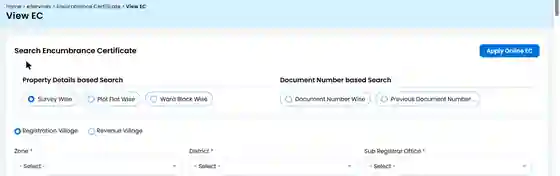
Not sure how far back the online data goes for your SRO? The View EC page has a “Click Here to know data availability period” link under the captcha. The Previous Document Number Wise option is labelled on the portal as covering data from 13-2-2018 onwards.
Tips for a correct EC search
- Give the old survey number too. The official Citizen Charter warns that if an old survey number existed for the new survey number and you do not state it, entries under the old number will not be reflected.
- Pick the right SRO. Search the Sub Registrar Office that had jurisdiction over the village when each deed was registered. Jurisdictions change; check “Know Your Jurisdiction” on the portal.
- Registration village vs revenue village: if a search returns nothing, try the other village type.
- Search sub-divisions separately when the land was split (for example 45/1, 45/2A).
How to Apply Online EC and Download a Signed Copy
The on-screen View EC result is good for a quick check. For a bank, court or registration office you need the digitally signed EC. The Citizen Charter says you can apply online for an EC for any property in any Sub Registrar Office in Tamil Nadu, and the EC is delivered at your login on payment of the requisite fee and delivery charges.
- Click User Registration at the top right of tnreginet.gov.in and create a citizen account.
- Open View EC and click Apply Online EC; sign in with your username, password and captcha.
- Enter the same property details (zone, district, SRO, village, survey number, period).
- Pay the fee online. The Registration Department accepts e-payment for any amount.
- When the SRO processes it, download the digitally signed EC from your login.
Official EC Fees in Tamil Nadu
This is the fee table published under Duty and Fees > Fees for getting encumbrance certificate for one survey number on tnreginet.gov.in:
| Fee head | Amount |
|---|---|
| E.C. application fee | Rs 1 |
| Search fee for the 1st year | Rs 30 |
| Search fee for every additional year | Rs 10 |
| Additional fee in the computerised period (from 1987) | Rs 200 |
| Urgent EC in the non-computerised period | Double the required fee |
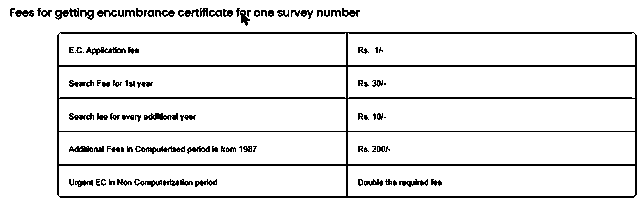
Example: an EC for one survey number for 30 years works out to Rs 1 + Rs 30 (first year) + Rs 290 (29 more years at Rs 10) = Rs 321, plus Rs 200 for the computerised period, which is Rs 521 before any delivery charge shown at payment. The final figure is calculated by the portal, so treat this as a guide.
Certified Copy of a Registered Document
If you need a copy of the sale deed or mortgage deed itself (not just the EC list), apply for a certified copy. The Citizen Charter says any person may apply online for a certified copy of a document registered in Book I (sale, exchange, mortgage and similar deeds). There are limits:
- A copy of a registered Will can be obtained only by the testator; after the testator’s death, any person can get it on producing the death certificate.
- A copy of a Power of Attorney registered in Book IV is given only to the parties concerned.
- Digitally certified copies can be obtained by applying online.
| Certified copy fee head | Amount |
|---|---|
| Application fee | Rs 1 |
| Search fee for the 1st year | Rs 10 |
| Computer fees | Rs 200 |
| Copying fee (scanned copy), per page | Rs 10 |
| Stamp duty | Rs 100 |
Tamil Nadu Stamp Duty and Registration Fee (Official Table)
Once the EC is clean and you go ahead with the purchase, these are the rates printed on tnreginet.gov.in under Duty and Fees > Stamp Duty and Registration fee. Duty is charged on the market value (guideline value) of the property unless stated otherwise.
| Document | Stamp duty | Registration fee |
|---|---|---|
| Conveyance (sale) | 7% of market value | 2% of market value |
| Gift | 7% of market value | 2% of market value |
| Exchange | 7% on the property of greater value | 2% on the property of greater value |
| Settlement in favour of family members | 1%, maximum Rs 40,000 | 1%, maximum Rs 10,000 |
| Settlement (other cases) | 7% | 2% |
| Partition among family members | 1%, maximum Rs 40,000 per share | 1%, maximum Rs 10,000 per share |
| Partition among non-family members | 4% for separated shares | 1% for separated shares |
| Release among family members (co-parceners) | 1%, maximum Rs 40,000 | 1%, maximum Rs 10,000 |
| Release among non-family members | 7% | 1% |
| Simple mortgage | 1% of loan, maximum Rs 50,000 | 1% of loan, maximum Rs 15,000 |
| Mortgage with possession | 4% of loan | 1%, maximum Rs 2,00,000 |
| Memorandum of deposit of title deeds | 0.5% of loan, maximum Rs 40,000 | 1% of loan, maximum Rs 8,000 |
| Agreement to sale | Rs 200 | 1% of money advanced (1% of total consideration if possession is given) |
| Construction agreement | 1% of construction cost / value / consideration, whichever is higher | 3% of the same |
| General Power of Attorney to sell immovable property (non-family) | 1% of market value | 1% of market value |
| General Power of Attorney to sell immovable property (family member) | Rs 1,000 | Rs 2,000 |
| Lease below 30 years | 1% of total rent, premium, fine etc. | 1%, maximum Rs 40,000 |
| Cancellation | Rs 1,000 | Rs 500 |
A computerisation fee of Rs 100 is also collected with the registration fee. Stamp duty can be paid by e-stamping at authorised bank branches or through licensed stamp vendors, who must sell at face value. Registration charges can be paid by POS machine up to Rs 1,000, by demand draft below Rs 5,000, or by e-payment for any amount.
Guideline value
Stamp duty is worked out on the guideline value of the land (plus the PWD rate for any building). TNREGINET publishes statewide guideline values online for these periods: from 1-7-2024 till date, 1-4-2023 to 30-6-2024, 9-6-2017 to 31-3-2023, 1-4-2012 to 8-6-2017, 1-8-2007 to 31-3-2012, 1-4-2003 to 31-7-2007 and 1-4-2002 to 31-3-2003. If you do not accept the guideline value, the document is referred to the District Revenue Officer / Special Deputy Collector (Stamps) to fix the market value; any difference in duty not paid within 2 months attracts 1% interest per month.
Registering the Sale Deed After the EC Check
The Citizen Charter lists what you need to present a document for registration at the Sub Registrar Office:
- The executed document, signed on every page by the executants, with two witnesses signing the last sheet. For a sale deed, both seller and buyer sign and appear before the registering officer.
- Photocopies of identity cards of all executants (and of witnesses for a power of attorney); originals are shown for verification.
- PAN of seller and buyer if the value exceeds Rs 5 lakh, or Form 60/61 if PAN is not available.
- FMB / Topo sketch if the extent is below 20 cents or the officer suspects it is a house site; Patta / Patta Pass Book / 10(1) statement for agricultural property in the notified 9 districts.
- NOC from the authority if the land may belong to Government, HR&CE or the Wakf Board.
- Registration fee plus the Rs 100 computerisation fee.
A document must be presented within four months of execution (the District Registrar may condone a further four months). There is no time limit for Wills. Documents for property in Tamil Nadu must be registered in Tamil Nadu: the charter notes that such documents registered outside the state are null and void with effect from 29-3-1997.
Presence-less registration (new)
TNREGINET now offers Presence Less Registration, with no queue and no token booking, for four kinds of deeds: first sale of a plot (by a promoter), first sale of a flat (by a builder or promoter), deposit of title deeds and deed of receipt (both by banks and NBFCs). The steps shown on the portal are party details, Aadhaar eKYC, online payment, document submission and registration. Ordinary resale deeds between individuals still need the parties to appear at the SRO.
EC Not Showing or Wrong? Troubleshooting
| Problem | What to do |
|---|---|
| “No Documents registered during the Search Period” | Check the SRO jurisdiction for those years, add the old survey number, and try Revenue Village instead of Registration Village. |
| Captcha error again and again | Refresh the captcha with the round arrow and type it exactly as shown. |
| Old records (before computerisation) missing | Use the data availability link; for older years apply at the SRO with the free EC application form. |
| Login pop-up appears on Apply Online EC | Applying for a signed EC needs a TNREGINET account: register with User Registration first. |
| Wrong entry or name in the EC | Contact the Sub Registrar Office concerned or the complaints helpline 9498452110. |
| Payment debited but EC not delivered | Raise a support request on the portal (Support Request Status) or call 1800 102 5174. |
If a time-bound service is delayed in spite of meeting all requirements, the charter says you can approach the District Registrar, the Zonal Deputy Inspector General of Registration or the Inspector General of Registration in Chennai, use the suggestion box at the SRO, or email helpdesk@tnreginet.net. District and zonal officers stay in office on all working Mondays to hear grievances. Remember: giving or demanding a bribe is an offence; complaints can go to the Directorate of Vigilance and Anti-Corruption.
Related guides: Tamil Nadu patta chitta online, Karnataka Kaveri EC online, ULPIN (Bhu-Aadhaar) land ID and Bhu Naksha land maps.
FAQs
Q. Is viewing EC online free in Tamil Nadu?
A. Yes. The View EC search on tnreginet.gov.in shows the registered transactions for a survey number without a login. A digitally signed EC is a paid service through Apply Online EC.
Q. What is the EC fee in Tamil Nadu?
A. For one survey number: Rs 1 application fee, Rs 30 search fee for the first year, Rs 10 for every additional year, and Rs 200 additional fee for the computerised period from 1987. An urgent EC for the non-computerised period costs double.
Q. How many years should I check in the EC?
A. Banks and lawyers usually ask for 13 to 30 years. Choose the start and end dates on the View EC page to cover that period.
Q. Can I get an EC for a property in another district online?
A. Yes. The Citizen Charter says you can apply online for an EC for any property in any Sub Registrar Office in Tamil Nadu.
Q. Why does my EC show no documents?
A. The SRO, village type or survey number may be wrong, or the old survey number was not given. The official charter warns that entries under an old survey number will not show unless you state it.
Q. What is the stamp duty on a sale deed in Tamil Nadu?
A. 7% stamp duty and 2% registration fee on the market value of the property, as per the Duty and Fees table on tnreginet.gov.in.
Q. Who can get a certified copy of a registered Will?
A. Only the testator during their lifetime. After the testator’s death, anyone can get it by producing the death certificate.
Q. What is the TNREGINET helpline number?
A. Complaints and clarifications: 9498452110, 9498452120, 9498452130. Software queries: 1800 102 5174. Email: helpdesk@tnreginet.net.
Source: tnreginet.gov.in View EC page, Duty and Fees page and Citizen Charter, checked 27 November 2026. Fees and rates can change; the portal shows the final amount at payment.
Official links
Always verify dates and fees on the official website before applying.
Get free job alerts
New govt, bank and teaching jobs, admit cards and results. No spam.